 Nucleus
Study Guides Built Like Systems,
Not Summaries.
Mitochondria diagrams with executive-grade clarity. Enzyme pathways that read like boardroom flowcharts. Every guide engineered for retention — not just comprehension.
Memorizing the Krebs Cycle in 72 Hours
Jordan had 72 hours before a biochemistry midterm covering all 8 Krebs Cycle intermediates, their enzymes, and the exact electron carriers produced at each step. Rote memorization from the textbook had produced nothing that stuck — the cycle felt like a wall of disconnected names.
Nucleus Krebs Cycle System Map — a single-page annotated diagram showing inputs, outputs, enzyme names, and carbon counts at each node, with the mnemonic "Citrate Is Krebs' Starting Substrate For Making Oxaloacetate" embedded as a visual legend.
One glucose molecule produces 2 acetyl-CoA units, so the Krebs Cycle runs twice per glucose. Each turn yields: 3 NADH, 1 FADH₂, 1 ATP, 2 CO₂. The electron carriers (NADH, FADH₂) then fuel the electron transport chain to produce 30–40 ATP total.
“Citrate Is Krebs' Starting Substrate For Making Oxaloacetate”
Jordan answered all 8 Krebs intermediates in order without hesitation, citing the mnemonic as the anchor. The annotated diagram had replaced 14 pages of textbook reading with one calibrated visual reference.
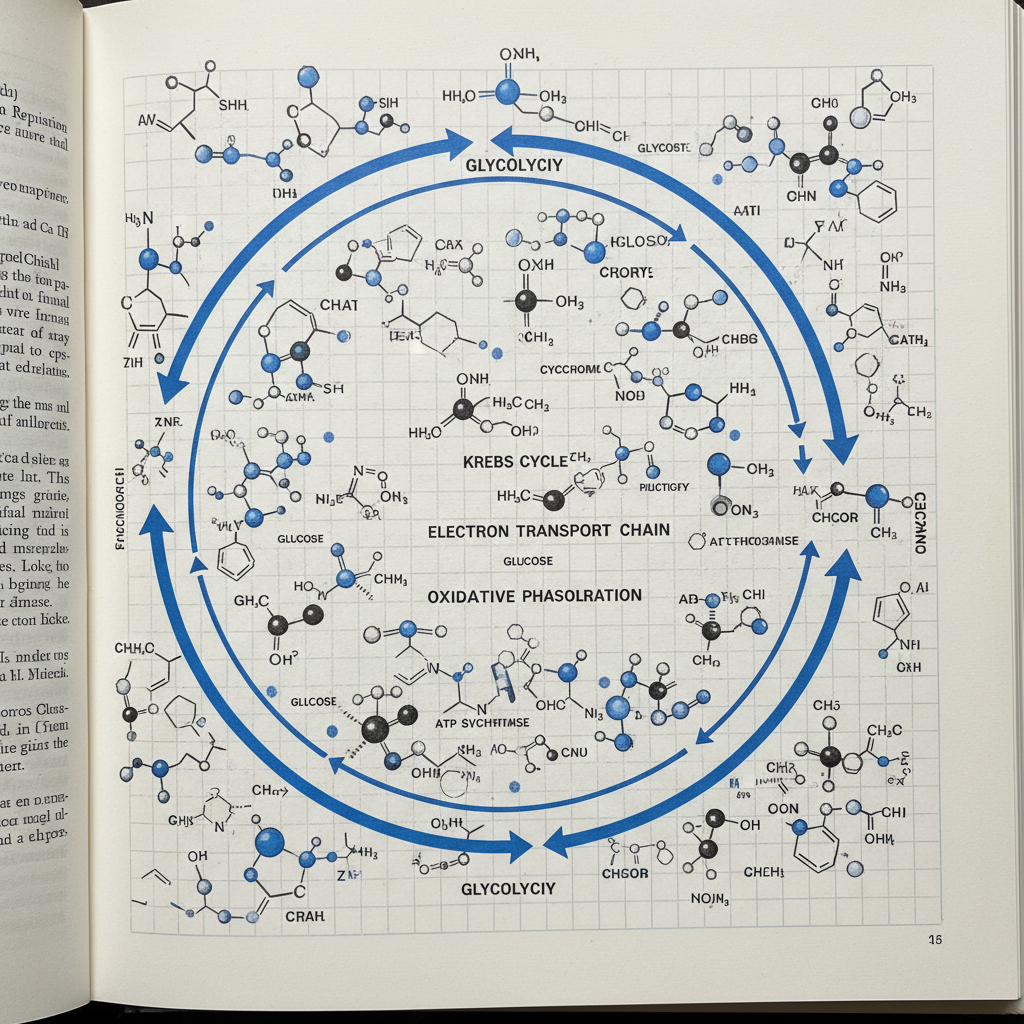
Visual Mnemonics That Stick for the May Exam
Sofia's AP Bio exam was 3 weeks out. She could recite definitions but blanked on application questions — "explain how a disruption to the electron transport chain affects ATP yield." The concept map in her review book was a tangle of arrows that meant nothing under pressure.
Nucleus AP Bio Visual Mnemonic Pack — a curated set of 18 diagrams built specifically around College Board learning objectives, with each diagram annotated at the "exam-ask" level: what AP Bio tests, what it doesn't, and why.
AP Biology does not require students to know the exact intermediate molecules of the Krebs Cycle by name. The exam tests conceptual flow: inputs → outputs, aerobic vs. anaerobic, and the relationship between glycolysis, Krebs, and ETC. Nucleus diagrams are calibrated to this scope.
Sofia scored a 5 on the AP Biology exam. She reported that the visual mnemonic framework made application questions feel like "reading a flowchart" rather than recalling isolated facts. Three weeks of structured visual review replaced six weeks of scattered note-taking.

Reference Sheets That Project Cleanly in Recitation
Marcus ran two recitation sections per week for Bio 201. His hand-drawn diagrams were accurate but illegible on the projector. Students couldn't distinguish enzyme labels from substrate names. He needed reference sheets that were designed for projection — high contrast, clean callouts, no visual noise.
Nucleus TA Projection Pack — 40 print-and-project reference sheets built at 1920×1080 resolution, with surgical gray labels, clinical blue callouts, and a grid-aligned layout that reads clearly from 30 feet.
Every Nucleus diagram is built at screen resolution with a minimum 4:1 contrast ratio between labels and background. The surgical gray / clinical blue palette was chosen specifically because it reads as sharp-edged under projector wash — unlike yellow highlighter or red annotations, which bloom.
Marcus's recitation section received a 4.9/5.0 student satisfaction rating — the highest in the department that semester. Students cited "clear diagrams" and "actually being able to read the labels" as primary reasons. He now uses Nucleus as the standard reference system for all TA onboarding.

Peer-reviewed methodology. Built with input from 14 university biology educators.